
Hopewell City Directory Collections and Access
Hopewell does not have a confirmed, published run of directory titles and years in the official pages inspected for this research. That absence matters. The Library of Virginia city-directory guide is a useful starting point, but it does not establish a particular Hopewell title, publisher, or year range. Confirm the catalog record or ask the holding institution before citing a volume. Hopewell is an independent city, so modern records should not be silently filed as Prince George County material.
| Collection route | Years or date runs | Where held | How to use it |
|---|---|---|---|
| Library of Virginia city-directory research guide | Exact Hopewell run: verify catalog | Library of Virginia | Use the guide and catalog as a starting point for titles and repositories. |
| Hopewell locality records on microfilm | Verify catalog | Library of Virginia locality records | Ask about locality microfilm and related city or county-era material. |
| Leake Local History and Genealogy Room | Exact directory holdings: verify catalog | Appomattox Regional Library, Hopewell | Consult non-circulating primary material on site. |
| Leake digital collection | Item dates vary; directory run not confirmed | Online local-history collection | Search documents, photographs, slides, and books by locality and topic. |
Those Hopewell catalog checks are more useful than guessing from a neighboring locality. A missing year can mean the volume was not acquired, has not been digitized, or is described under City Point or an earlier jurisdiction. Treat an apparent gap as a lead for a second repository, not as proof that no directory ever existed.
Hopewell City Directory Research at the Leake Room
The Appomattox Regional Library lists the Hopewell branch at 209 E Cawson Street, with the Leake Local History and Genealogy Room on the second floor. Its primary documents, photographs, slides, and books are for on-site use and do not circulate. An appointment or advance contact with local historian and archivist Jeanie Langford is recommended when a search depends on a particular volume, a local surname, or a fragile item. The Hopewell branch phone is 804-458-6329.
See the Leake Local History and Genealogy Room access information before a visit.
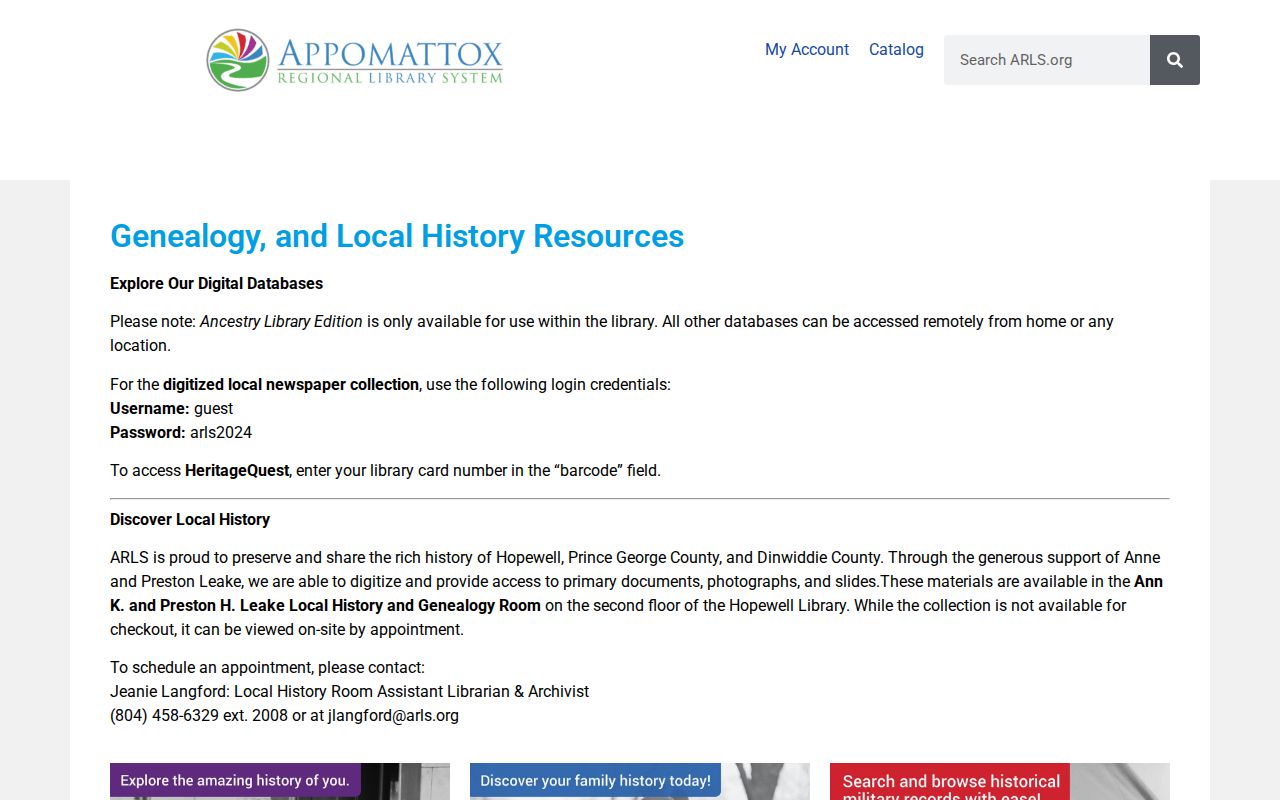
The room's on-site rule is especially important for Hopewell city-directory research because a shelf or file may supply context that a search result cannot, such as a local-history book, a photograph, or a catalog clue. Bring the name variants and approximate address already found, then ask whether the collection has material under Hopewell, City Point, or Prince George-era headings.
Note: Exact Hopewell city-directory titles, publishers, and year runs still require a catalog or staff confirmation.
Search Hopewell City Directory Clues in the Leake Digital Collection
The Leake digital collection covers Hopewell, Prince George County, and Dinwiddie County. It provides a text-query field, an exact-match checkbox, a record-type filter, and a Search control. That makes it a practical companion to a city directory search when the name, street, organization, or local event needs historical context. It is not evidence that the collection contains a complete directory run.
Open the Leake digital collection search interface to begin with a locality and surname combination.
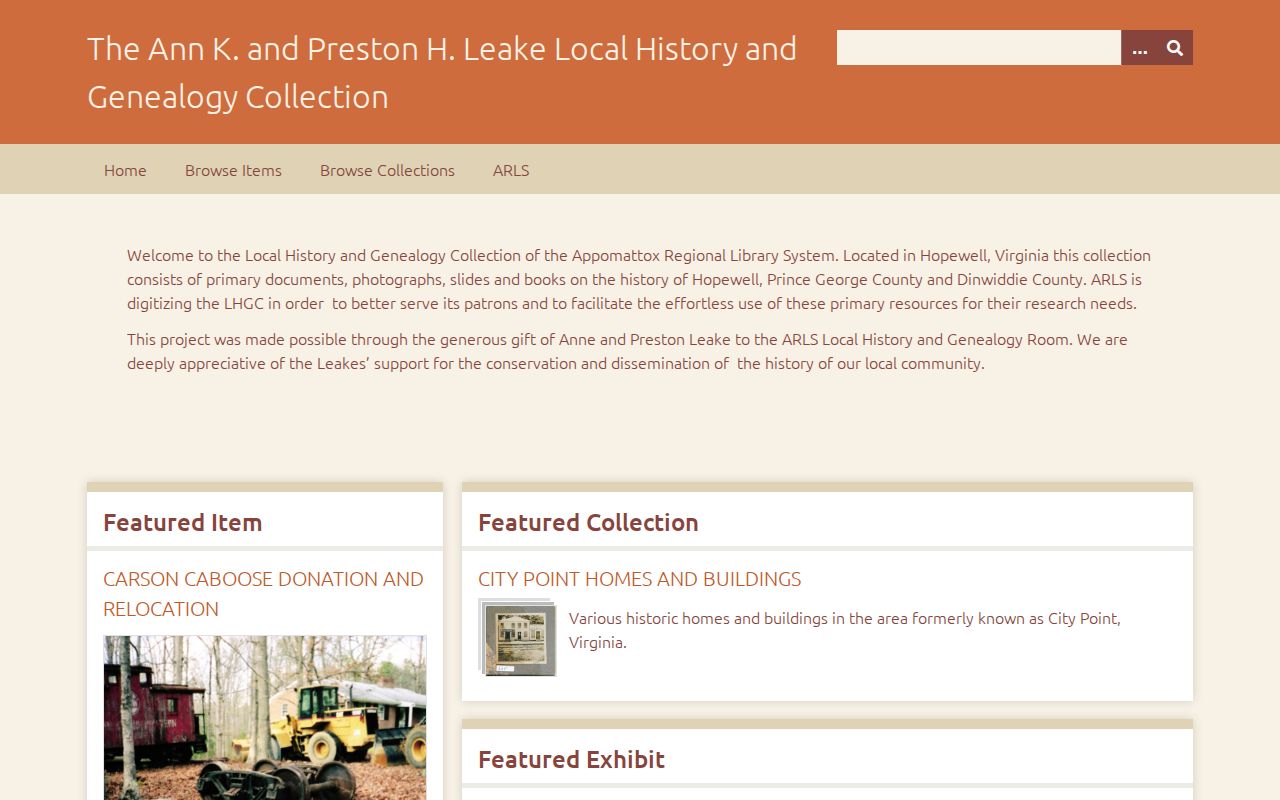
Use exact match only after trying broad wording first. A Hopewell historical item may use a shortened given name, a former street name, City Point, or Prince George County rather than the modern Hopewell label. Record the item title, creator if shown, date, and repository link beside any directory notation.
Reading a Hopewell City Directory Entry with Care
No public source inspected supplied a sample entry from a confirmed Hopewell city directory. The inventory below therefore describes common city-directory conventions, not verified fields from a Hopewell volume. Read the abbreviation page, title page, and publication date before extracting names. A convention seen in one directory should never be assumed to have the same meaning in another Hopewell volume.
| Name line | A surname and given name or initials may identify the listed person; compare spelling across nearby years. |
|---|---|
| Street address | Directories commonly print a number and street, but old locality names or numbering can complicate the match. |
| Occupation wording | Some directories include an occupation or business reference; it is a historical clue, not proof of a full life history. |
| Family notation | Some volumes use spouse, widow, boarding, or relationship shorthand. Verify each abbreviation in that volume. |
| Owner or occupant mark | Where present, symbols or labels must be read from the volume's own key rather than assumed from a general directory rule. |
- Criss-cross directory
- A street-order section that can group entries by address when the particular volume includes one.
- Householder index
- An index organized around household names, often useful when a printed name differs from the street listing.
- Abbreviation key
- The volume's explanation of its shorthand, usually worth photographing or transcribing before interpreting an entry.
Hopewell City Directory Context: City Point Through Incorporation
Hopewell place history changes the way a city directory search is framed. The City of Hopewell history identifies City Point, tobacco warehouses, Civil War activity, the DuPont development, the 1915 fire, incorporation, industrial change, and historic places. A name or address associated with an earlier period may be better found through a City Point search or a Prince George County-era record before it appears under the modern Hopewell identity.
View the City History reference for the municipal chronology.
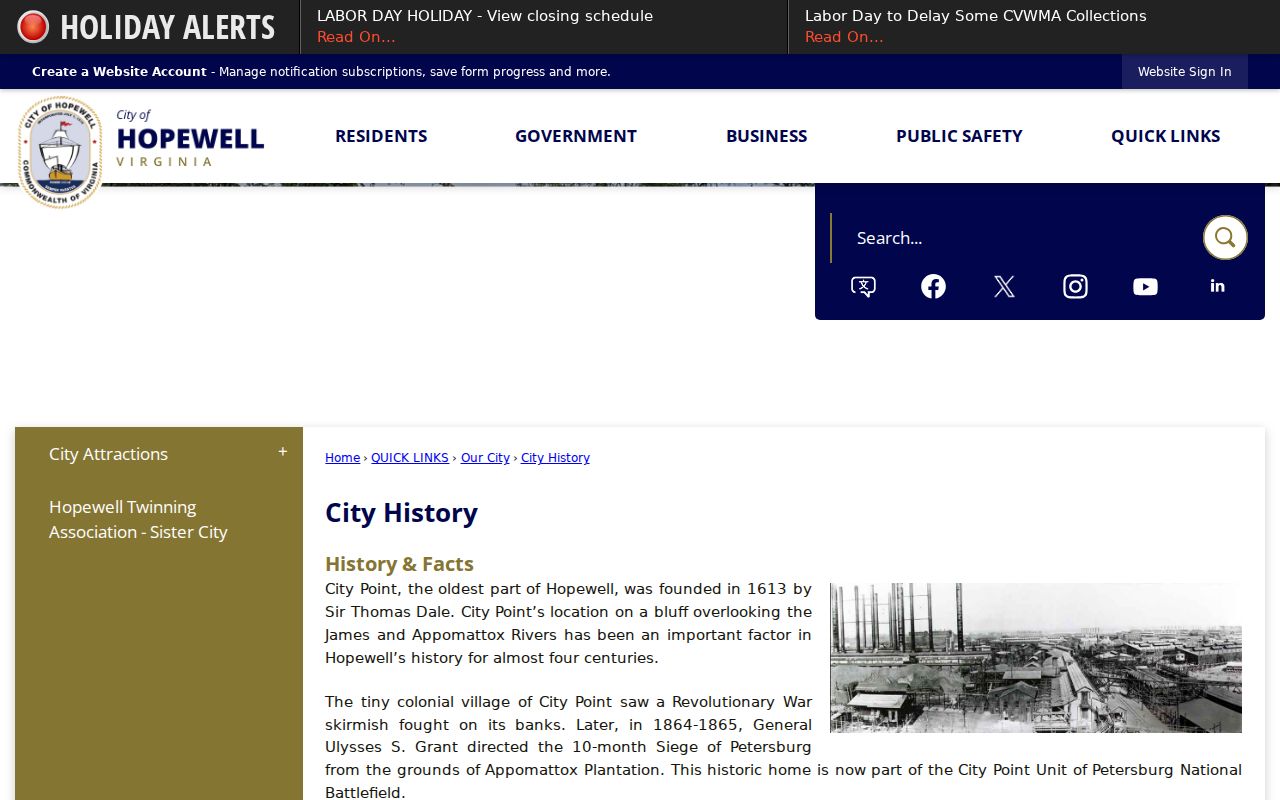
That history gives a useful timeline for interpreting a directory or library hit:
- 1613: the locality history traces Hopewell's establishment to this date.
- 1914: the DuPont development altered the community's industrial and population context.
- 1915: a fire destroyed much of Hopewell during that industrial boom.
- 1916: Hopewell became an independent city.
- 1923, 1952, and 1969: City Point and later Prince George County annexation history can affect the jurisdiction named in an older record.
Historical Community Memory at Hopewell Foundation
The Historic Hopewell Foundation preserves and interprets Weston Manor and St. Denis Chapel. Its work is a useful human-history complement to formal indexes because community memory, preservation records, and local interpretation can explain why a household, place, or family name matters in a particular part of Hopewell. The Foundation lists its contact at 400 Weston Lane, Hopewell, VA 23860, and 804-458-4682.
Consult the Historic Hopewell Foundation for its preservation work and contact details.
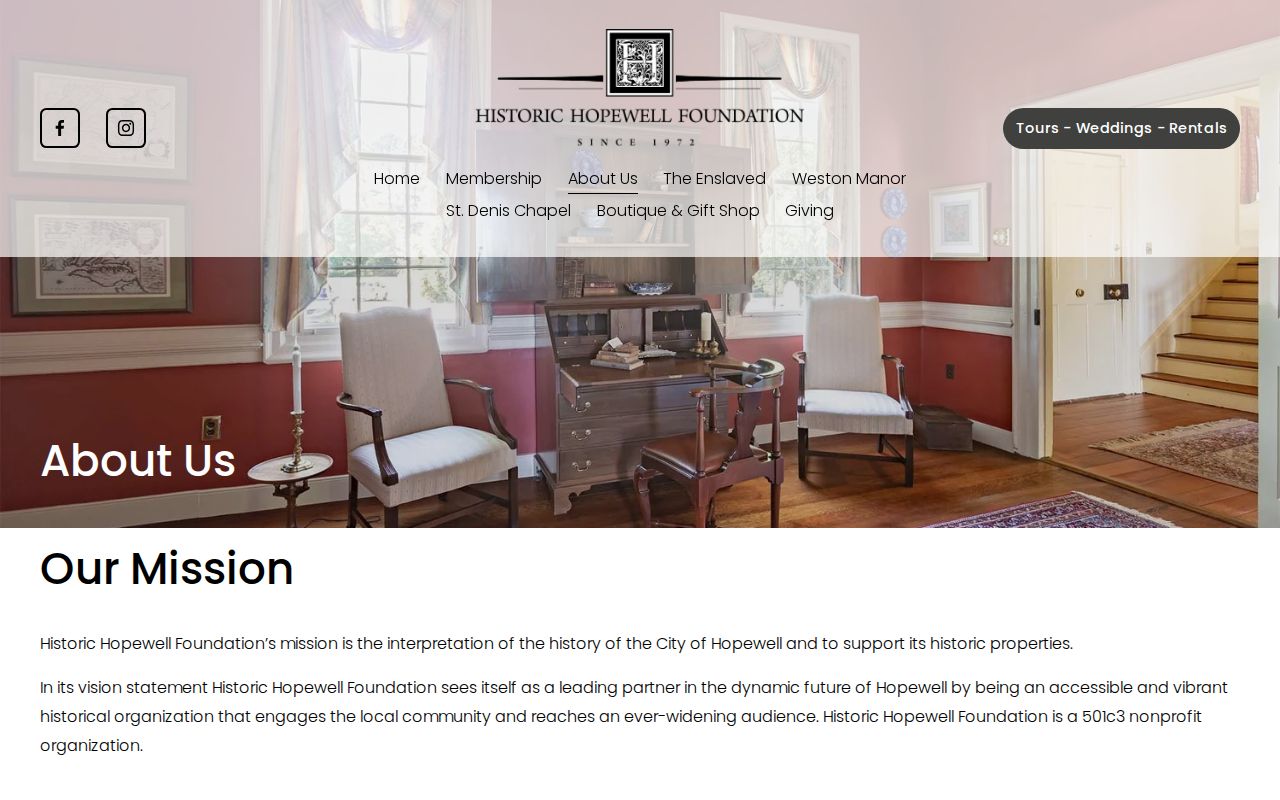
The Foundation's interpretive material should be used to add Hopewell context to a documented directory or archive finding. It is not a substitute for a catalog record, a deed, a census schedule, or a record of an individual person's current circumstances.
Trace a Hopewell Household Through City Directories
A city directory becomes more useful when each appearance is treated as a dated observation rather than a full biography. Pairing it with the federal census, local archives, and public probate or land records can separate a genuine move from a spelling change or a skipped volume. The current public decennial census is 1950, so more recent household details should not be inferred from a historical directory.
- Find the earliest confirmed appearance of the name, noting the repository, volume date, spelling, and locality label.
- Check each available later volume for the same surname, address, and any changed initials or relationship notation.
- If the volume offers a street-order section, use it as an address clue and preserve the exact page reference.
- Pair a directory date with the closest available census schedule, using City Point or Prince George County only when the era calls for it.
- Use probate, wills, cemetery research, or a local-history item to test why the person disappears, without assuming the cause from absence alone.
For an address-centered historic trail, the Hopewell past residents resource keeps the focus on deeds, land books, and successive households instead of re-listing the collection shelves.
Use Historic Names Beside Hopewell City Directories
Search the same question through several era labels: City Point for earlier material, Hopewell for the independent city, and Prince George County when a record predates a boundary change or concerns annexed territory. The Library of Virginia locality history ties those changes to Hopewell's 1916 city status, the 1923 City Point annexation, and later annexations in 1952 and 1969. Keep the record date beside the name used in the search.
A 1915 Petersburg Sanborn item at the Library of Congress names Hopewell among places on the original map, but no standalone Hopewell Sanborn sheet was located in this research. Catalog verification is still needed before relying on a map as city-directory evidence.